The Council.
Fourteen investors whose books form the substrate of the Blue Portfolio. The rules I trust are the ones where the Council overlaps.
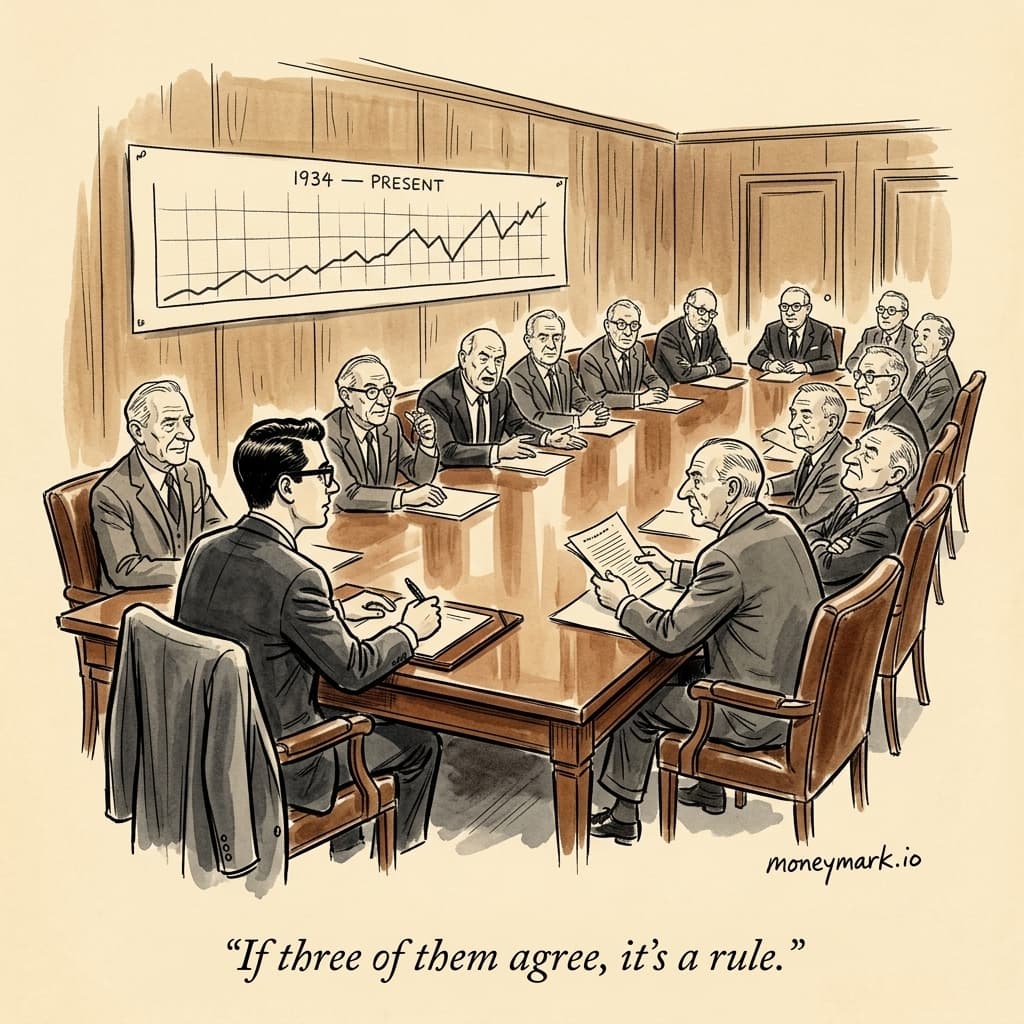
I didn't invent any of the rules in the Blue Portfolio. Every one of them was written down decades ago by someone who paid the tuition, lived through a cycle, and put it in a book. I read the books. I wrote down what fourteen of them agree on, and where they disagreed I picked a side on purpose. That's the Council.
This post names them.
If you're new here, this is one of three foundation posts. The other two are the ETF Portfolio — the broad-market portfolio I'd hand to almost any reader — and the Blue Portfolio — the hand-picked book the Council's rules actually shape. Read them in any order.
Why a council, not a hero
No single investor in this group got everything right.
Warren Buffett famously underrated technology for decades. Benjamin Graham's deep-value math was designed for the asset-heavy industrial economy of 1934 and stretches uncomfortably over modern intangible businesses. Peter Lynch's "buy what you know" gets dangerous when "what you know" is one company in one sector. Each of these investors is right about some things and wrong about others. Treating any of them as the hero is a way to inherit their blind spots.
A council fixes that. A rule that one investor on the list believes is something I hold with judgment — strong influence, not a hard law. A rule that three or more believe, working in different decades on different continents under different market regimes — that's a rule I treat as inviolable. The strategy lives where the overlap is.
The fourteen
Roughly chronological. The order doesn't matter much — what matters is that fourteen authors, working in different decades and different markets, converged on most of the same rules.
- Benjamin Graham — Security Analysis (with David Dodd, 1934) and The Intelligent Investor (1949). The founding text of value investing. Everything downstream is a refinement, an extension, or a correction of Graham.1
- Philip Fisher — Common Stocks and Uncommon Profits (1958). The qualitative half of the toolkit. What a great business actually looks like up close, before the financial statements catch up.2
- Warren Buffett — six decades of Berkshire Hathaway annual letters. The synthesis: pay a sensible price for a good business. Not cheap. Sensible.3
- William O'Neil — How to Make Money in Stocks (1988). The technical-entry tradition. Pattern-based, momentum-driven, the discipline of buying strength rather than buying weakness.4
- Peter Lynch — One Up on Wall Street (1989). The everyday investor's playbook, from the manager who ran Fidelity Magellan during its best run. Common sense, written down.5
- James O'Shaughnessy — What Works on Wall Street (1996). Multi-decade backtests across rolling windows. The empirical foundation — which rules actually work over the long run, and which are stories.6
- Joseph Piotroski — Value Investing: The Use of Historical Financial Statement Information to Separate Winners from Losers (Journal of Accounting Research, 2000). A short composite of accounting checks that distinguishes financially healthy businesses from quietly failing ones.7
- Joel Greenblatt — The Little Book That Still Beats the Market (2005, updated 2010). The case for mechanical value investing — that a simple, repeatable system can beat most active management.8
- John Bogle — The Little Book of Common Sense Investing (2007). The case for not picking stocks at all. On this council precisely because he disagrees with the rest of it.9
- Louis Navellier — The Little Book That Makes You Rich (2007). The quantitative case that current operating momentum, used correctly, separates real businesses from value traps.10
- Pat Dorsey — The Little Book That Builds Wealth (2008). The closed taxonomy of economic moats. What makes a competitive advantage durable, and what only looks like one.11
- Howard Marks — The Most Important Thing (2011). Risk as the probability of permanent loss, not the volatility of the chart. Cycles, contrarianism, second-level thinking.12
- William Thorndike — The Outsiders (2012). Eight CEOs who outperformed by being unfashionable about capital allocation. Picking a great business is also picking a great manager.13
- Aswath Damodaran — NYU Stern, ongoing. The valuation reference, plus a public archive of papers, lectures, and spreadsheets. Every multiple decomposed into the variables that drive it.14
A rule and where it comes from
Take one rule from the Blue Portfolio: pay a sensible price for a good business.
Buffett wrote the synthesis. Lynch operationalised it with PEG. Damodaran decomposed it into the three drivers. Greenblatt mechanised it into the Magic Formula. Four investors, four angles, the same conclusion — written and rewritten across fifty years.
That's a Council rule. When I make a trade that obeys it, I'm not following Mark; I'm following the overlap of four people who, between them, lived through more market regimes than I will.
Where the Council disagrees
The interesting part. The strategy isn't a vote — it's a position taken on purpose.
Bogle versus everyone else who picks stocks. Bogle says active investing is a losing bet for almost everyone, full stop. Every other author on the list runs or describes an active strategy. My resolution: Bogle is the bar, not the strategy. The Blue Portfolio is legitimate only if it beats the broad-market index after costs over rolling windows. The ETF Portfolio in my own LIRA exists because I take Bogle's argument seriously enough to keep an entire portfolio dedicated to it. If the Blue Portfolio fails to beat that portfolio over a long enough stretch, Bogle was right and I was wrong.
Graham versus Fisher. Graham wanted roughly a hundred names bought at deep discounts to liquidation value, with no concentration. Fisher wanted ten to twenty outstanding businesses, held tightly, for decades. My resolution: somewhere in between, and leaning toward Graham's diversification more than Fisher's concentration. The Blue Portfolio runs around forty names — diversified enough that no single thesis being wrong sinks the book, focused enough that I can do the Layer 5 verification work on each one. The discipline is in the verification, not in the count.
O'Neil versus Greenblatt. O'Neil's seven-percent stop loss is a hard rule in a pure momentum portfolio. Greenblatt's three-to-five-year minimum holding period is the opposite — sit through the drawdown, the patience is the price. My resolution: different portfolios, different rules. The Blue Portfolio is patient by design and does not run a price-action stop. I sell when the thesis breaks, not when the chart wobbles. O'Neil's stop is right for a different game.
Volatility versus permanent loss. Academic finance defines risk as the volatility of the price chart — the Sharpe ratio is downstream of this view. Marks rejects it. Buffett and Graham implicitly reject it too. My resolution: Marks wins. Volatility is information; it isn't risk. Risk is the probability that I lose money I can't get back.
If you're reading and wondering whether to read all fourteen books
You don't have to. I have.
The point of naming the Council isn't to make you do the reading. It's so you know the rules I run in this brand aren't a personality — they're a synthesis of decades of mostly-overlapping work by people who, between them, have already paid the tuition I'd otherwise be paying myself.
If a rule shows up here and I cite only one author behind it, treat it as opinion. If three or more of the Council back it, the math is probably on the rule's side. That's the only inheritance test I run.
How the pieces fit
Three posts, one system.
- The Council is the source. Fourteen investors. Where they overlap is what I trust.
- The ETF Portfolio is what the Council prescribes for almost everyone — Bogle's argument, taken seriously.
- The Blue Portfolio is what the rest of the Council says you can build if you do the work. Quality + valuation + momentum + verification, run every Saturday, no shortcuts.
Both portfolios belong in the same system. The Council is why.
Footnotes
- Benjamin Graham and David Dodd — Security Analysis (McGraw-Hill, 1934); Benjamin Graham — The Intelligent Investor (Harper & Brothers, 1949). The two founding texts of fundamental analysis.
- Philip A. Fisher — Common Stocks and Uncommon Profits (Harper & Brothers, 1958; reprinted Wiley). The qualitative-investing canon and the origin of the "scuttlebutt" research method.
- Warren E. Buffett — Berkshire Hathaway annual shareholder letters (1965–present). Six decades of running commentary on what works in investing and why.
- William J. O'Neil — How to Make Money in Stocks: A Winning System in Good Times and Bad (McGraw-Hill, 1988). The CAN SLIM methodology and the foundational text of pattern-based technical entry.
- Peter Lynch (with John Rothchild) — One Up on Wall Street: How to Use What You Already Know to Make Money in the Market (Simon & Schuster, 1989). The everyday-investor playbook from the manager of Fidelity Magellan during its 1977–1990 run.
- James P. O'Shaughnessy — What Works on Wall Street: A Guide to the Best-Performing Investment Strategies of All Time (McGraw-Hill, 1996; multiple revised editions). Multi-decade backtests of strategies across rolling windows.
- Joseph D. Piotroski — Value Investing: The Use of Historical Financial Statement Information to Separate Winners from Losers, Journal of Accounting Research 38 (2000). The original F-Score paper.
- Joel Greenblatt — The Little Book That Still Beats the Market (Wiley, 2005; updated 2010). The Magic Formula, and the case for mechanical value investing.
- John C. Bogle — The Little Book of Common Sense Investing (Wiley, 2007; 10th-anniversary edition 2017). The canonical retail case for broad-market, low-cost, long-horizon indexing, from the founder of Vanguard.
- Louis Navellier — The Little Book That Makes You Rich: A Proven Market-Beating Formula for Growth Investing (Wiley, 2007). The quantitative-momentum case.
- Pat Dorsey — The Little Book That Builds Wealth: The Knockout Formula for Finding Great Investments (Wiley, 2008). The closed taxonomy of economic moats.
- Howard Marks — The Most Important Thing: Uncommon Sense for the Thoughtful Investor (Columbia Business School Publishing, 2011; Illuminated edition 2013). Risk redefined as the probability of permanent loss; cycles, contrarianism, second-level thinking.
- William N. Thorndike — The Outsiders: Eight Unconventional CEOs and Their Radically Rational Blueprint for Success (Harvard Business Review Press, 2012). Capital-allocation discipline as the diagnostic for great management.
- Aswath Damodaran — NYU Stern faculty page. The public archive of papers, lectures, datasets, and valuation spreadsheets that underpin the valuation tradition at NYU Stern.
— Mark