The ETF Portfolio.
The simplest portfolio I run, the one I'd hand to almost any reader, and the one that holds the rest of my work to account.
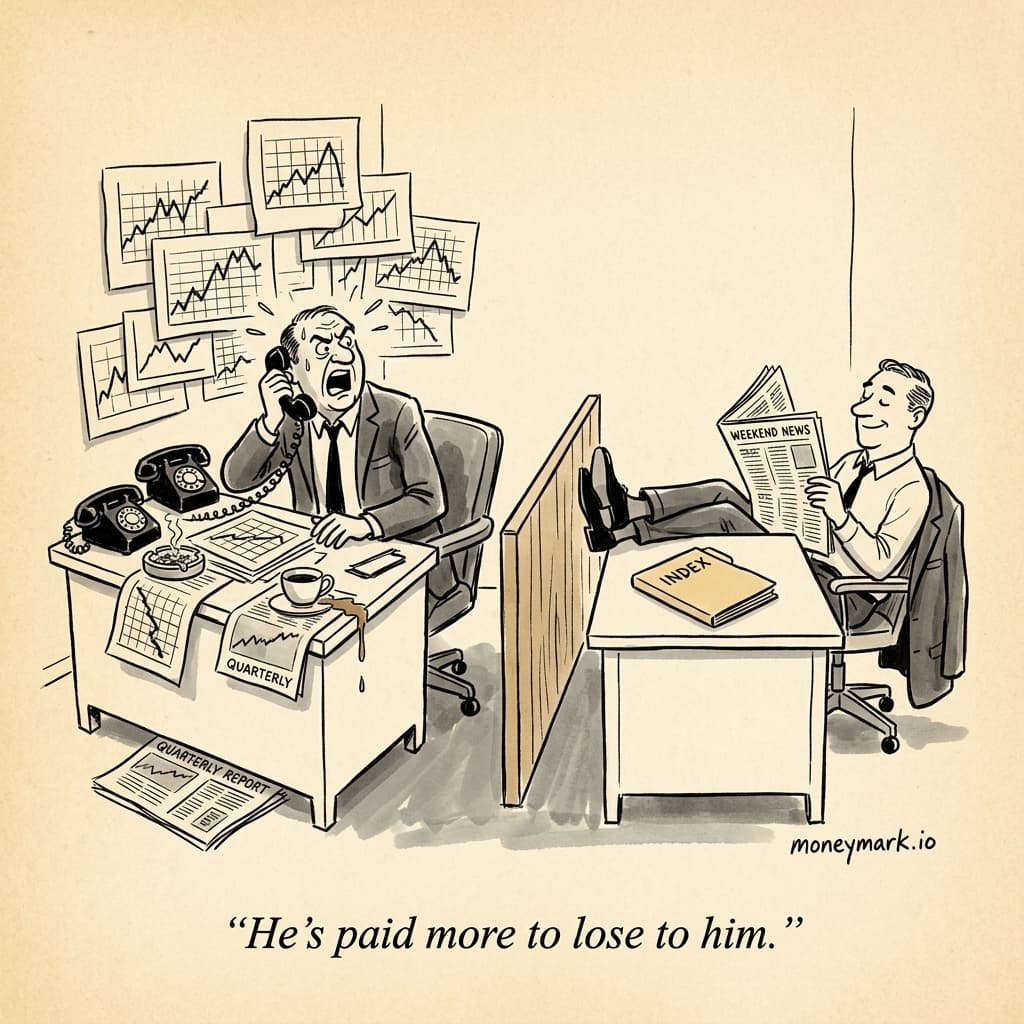
A few years ago I sat down to plan where my retirement money should go. The honest answer for almost everyone is one line long: a low-cost broad-market index fund. I started there. I still own one.
The ETF Portfolio is the simplest I run, the one I'd hand to almost any reader, and the one that holds the rest of my work to account.
If you're new here, this is one of three foundation posts. The other two are the Blue Portfolio — the hand-picked book I actually obsess over — and the Council — the fourteen investors whose books taught me the rules. Read them in any order. They explain the same system from three angles.
The argument that built this portfolio
Roughly nine out of ten active stock pickers fail to beat the broad market index over a ten-year window, after costs.1 That number is stable across decades, across countries, across fund types. It's not a fashion. It's the math of fees compounding against you while the market does its slow, boring work.
An ETF — exchange-traded fund — is a basket of stocks (or bonds) you buy with one ticker, the way you'd buy a single stock. A broad-market ETF holds hundreds or thousands of names, weighted by size, so you own the whole market in one click. A low-cost one charges you a fee measured in basis points, not percent.
Put those together and you get a vehicle that does the thing the math says wins: own everything, cheaply, for a long time.
What I actually own — three rules
I keep this portfolio simple on purpose. Three rules, written down before I bought anything, and they haven't changed.
- Broad market. Not sectors. Not themes. Not one country tilted heavily against another. The point of indexing is that you stop trying to guess which slice wins. You own them all in proportion to size.
- Low cost. Expense ratio under 0.20%. Most of what I hold is well under 0.10%.
- Inside a tax-sheltered account. Less drag from taxes on dividends and rebalancing. For me that's the LIRA — a Locked-In Retirement Account, the Canadian bucket pension money lands in when you leave a defined-benefit job. Different country, same idea: put the simplest portfolio where taxes won't nibble at it.
The whole portfolio trades roughly once a year, when I rebalance the weights back to target. That's it. The rest of the time I leave it alone.
What it looks like in the dashboard
A Canadian-listed S&P 500 fund and a Canadian total-market fund cover the US-large-cap and home exposures. A small bond fund sits beside them for ballast. The expense ratios add up to a rounding error.
When the market is up, the portfolio is up. When the market is down, the portfolio is down. There is no clever timing decision to make. There is no thesis to second-guess. The work is done by owning the businesses, in aggregate, and waiting.
The boring part is the point
There is nothing satisfying about owning a broad-market index fund. You don't have a thesis. You don't have a story you can tell at dinner. You don't get to feel smart when a stock inside the basket runs.
That's a feature, not a bug. The most reliable way I've found to lose retirement money is by owning a position I love. Love rationalises holding too long, averaging down into a thesis that broke, and ignoring the data that says the original idea was wrong. An index fund cannot be loved. There is no thesis to defend. The fund is up because the market is up; it's down because the market is down; the position size is what it is because that's what you contributed. There's no story to tell yourself.
The work this portfolio asks of you is roughly one hour a year. Pick a date — mine is the first weekend of January. Look at the weights. If equities have drifted from 70% of the portfolio to 78% because last year was good, sell a slice back to 70% and put the proceeds into the bonds that lagged. If they've drifted to 62% because last year was bad, sell a slice of bonds back to 30% and buy more equities while they're on sale. That's the whole job. Set a calendar reminder. Show up. Leave again.
In a bad year — and there will be bad years — the portfolio will be down 20%, 30%, occasionally more. The rule is simple and the rule is hard: rebalance into the drawdown. Buy what's been falling, with money raised from selling what's been holding up. That feels wrong every single time. Doing it anyway is most of the edge.
Where the simple version stops being simple
A few honest gaps. Reasonable people land on different sides of these — I'm not selling certainty.
Currency. A US-listed S&P 500 fund held in a Canadian account is a different animal from a CAD-hedged version of the same exposure. Over a thirty-year horizon I don't think anyone reliably outsmarts currency. Pick a side, write down why, and live with it.
Sector ETFs. Tempting. Resist. The minute you buy a "tech" or "energy" basket you've stopped indexing and started timing. The whole point of the portfolio is that you've decided not to do that.
Dividend ETFs, value ETFs, ESG funds — anything that isn't "the whole market by size." Each one is an active bet wearing index clothing. A dividend ETF picks the companies paying the biggest yields right now; a value ETF picks the stocks that look cheapest on a particular ratio; an ESG fund picks the companies that score best on a sustainability rubric. They look like indexing because they trade like an ETF, but the picking is happening — somebody else is doing it. Some of these tilts work. Most are expensive. If you want a tilt, own it as a tiny side position and be honest about what you're doing — not as the foundation.
If you're reading and wondering where to start
Start here. Before any individual stock. Before any screener. Before the Blue Portfolio.
If you're early in your career and not yet maxing a tax-sheltered account into a low-cost broad-market fund, you have a high-conviction move sitting right in front of you that doesn't require a single hour of research. Make it. Then read the rest of this site.
Most readers should stop at this post. That isn't a hedge — it's the math. Picking individual stocks is a job. If you don't want the job, the ETF Portfolio is the right answer, and there is no shame in it.
How the pieces fit
Three posts, one system.
- The ETF Portfolio is the floor. The bar everything else has to beat. The portfolio I'd hand to almost any reader.
- The Blue Portfolio is what I do on top of this portfolio, not instead. A hand-picked book of individual businesses, diversified across roughly forty names, run every Saturday because the work justifies the bet.
- The Council is the fourteen investors whose books taught me both portfolios exist for a reason — and where to draw the line between them.
If indexing is so reliable, why pick stocks at all? That's the question the Blue Portfolio answers. The ETF Portfolio is the answer for everyone else — including most of me.
Footnotes
- S&P Dow Jones Indices — SPIVA U.S. Scorecard. The semi-annual research that compares active U.S. equity managers against their benchmarks. Over a 20-year horizon roughly 92% of active U.S. domestic funds underperform; over a 15-year horizon recent scorecards have shown the figure reach 100% across all 22 equity categories tracked. "Nine out of ten" is a round-number summary of the long-horizon result.
- John C. Bogle — The Little Book of Common Sense Investing (Wiley, 10th-anniversary edition 2017). The canonical case for broad-market, low-cost, long-horizon index ownership, written by the founder of Vanguard and the originator of the first retail index fund.
— Mark