The Blue Portfolio.
If indexing wins on base rates, why pick stocks at all? The five-layer answer I work through every Saturday morning.
If indexing wins on base rates, why pick stocks at all? I asked myself that question for two years before I touched a single screener. The Blue Portfolio is the answer I worked out, and most people shouldn't bother building one.
Here's why I do, what it looks like, and what would have to be true for it to make sense for you.
If you're new here, this is one of three foundation posts. The other two are the ETF Portfolio — the broad-market portfolio I'd hand to almost any reader — and the Council — the fourteen investors whose books taught me the rules I run. Read them in any order.
The bar that justifies this portfolio
Indexing is the right default for almost everyone, almost all the time. That argument is the whole point of the ETF Portfolio. It's also the bar this portfolio has to clear.
A concentrated portfolio of outstanding businesses, bought at sensible prices and held for years through volatility, has a long history of beating the broad market.1 The investors in the Council — Buffett, Lynch, Fisher, Greenblatt, and a dozen more — built their careers on exactly that bet.
The catch is unforgiving. The strategies that beat the market only beat it because the people running them did the work. The ones that fail outnumber the ones that succeed by a wide margin, and most of the failures look exactly like the wins right up until the moment they stop.
The Blue Portfolio is my attempt at the version that works. The rest of this post is the discipline that makes the attempt honest.
The five layers, in plain English
Every Saturday morning I run the same pipeline. Five layers. Two failures and the name is out.
Layer 1 — clean data. Three separate screeners — Prospector, Bedrock, and Quantum — each pull from their own slice of the North American market. Different universes, different jobs, different definitions of "interesting." Layer 1 is the plumbing that gets the right data into the right screener in the right shape. Boring, load-bearing, hard to skip.
Layer 2 — fundamental gates. Each screener has its own hard pass/fail tests covering profitability, capital structure, valuation, and accounting health. The specifics differ by screener; the philosophy doesn't. A business that's overlevered, overpriced, structurally unprofitable, or flashing signs of accounting distress gets rejected here, no matter how good the story sounds.
Layer 3 — momentum and quality. A composite score — internally called the NMS — filters the survivors from Layer 2 down to businesses showing real, current operating momentum. The point isn't to chase price. The point is to separate good businesses from value traps — companies that look cheap on Layer 2 because they're quietly dying. A value trap fails Layer 3. A real business doesn't.
Layer 4 — entry timing. A live technical signal has to fire before I actually buy. The fundamentals tell me the business is worth owning; the technical alert tells me today is a reasonable day to own it. This is the youngest layer of the system and the one I'm still tightening.
Layer 5 — pre-buy verification. A three-check final pass before any trade. Is the volume profile clean? Has any material news landed since the screener ran? Do the fundamentals from Layer 2 still hold today? Any failure aborts the trade, even if everything else lined up. Layer 5 is the same idea as a flight attendant checking the door on a Boeing — most of the time it's redundant, and the one time it isn't, it's the whole thing.
What clears all five gates
The North American market is enormous, and the screeners do their job — every Saturday they hand me a short, real list of names that cleared the early layers. The Buy-Ready list isn't empty. It's just short, and that's the point.
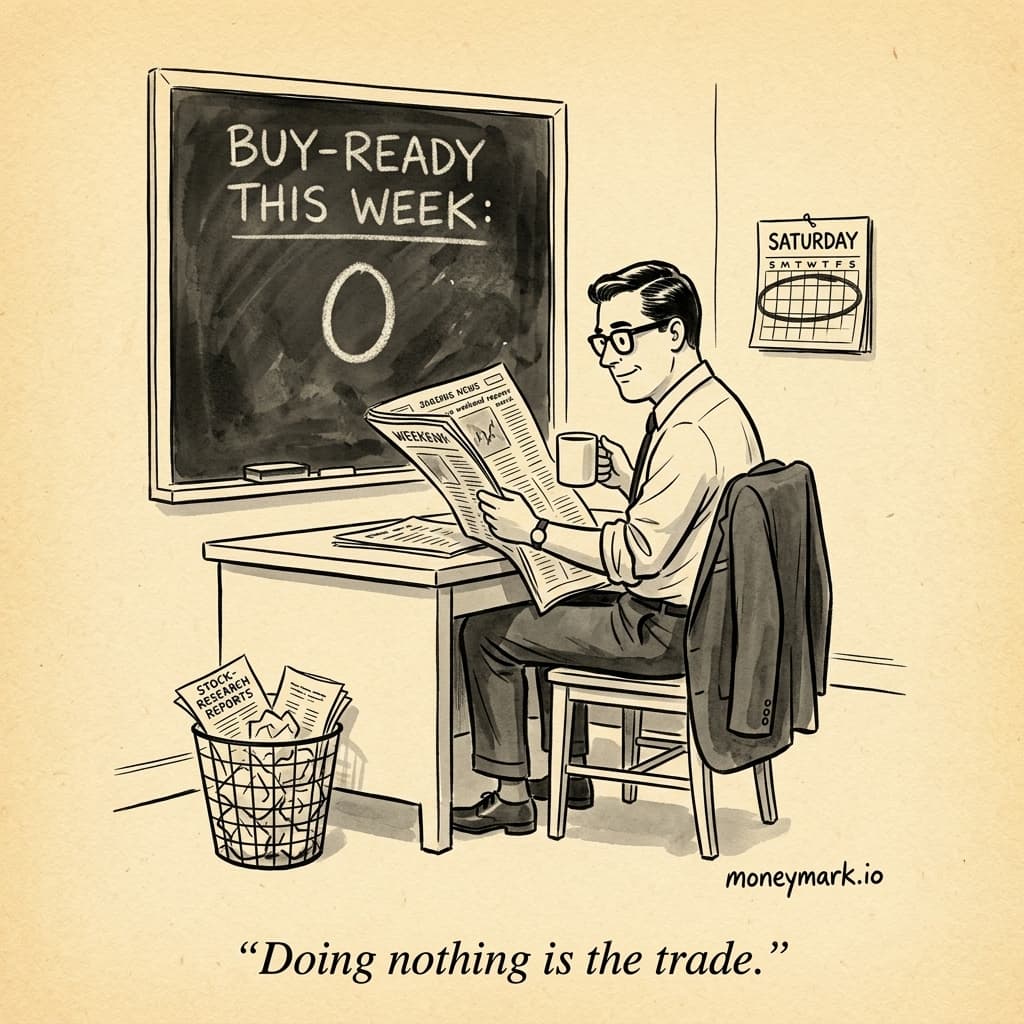
The Blue Portfolio is built on the assumption that the right call most weeks is still to do nothing, even when names clear the pipeline. A name that earns a spot in the book has to look like an exceptional business — strong margins, durable returns on capital, a debt load that won't force a fire sale in a recession, a valuation that doesn't require a miracle, and real operating momentum right now. On top of that it has to clear a live technical signal, a clean news scan, and a clean volume read.
There might be one of those in the queue on a given Saturday. There might be none. Both answers are fine.
What I won't do
A discipline that doesn't say no isn't a discipline. The Blue Portfolio rejects, on purpose:
- Tips, broker recommendations, social-media chatter. None of them pass Layer 2. If a name didn't survive the screener, it doesn't get a workaround because someone on TV liked it.
- Foreign small-caps, complex financials. Not my circle of competence. A business I can't model, I don't own.
- Pure momentum without a fundamental floor. The data on naked momentum strategies on individual stocks is roughly flat after trading costs.2 A momentum signal on a broken business is a value trap with a tailwind.
- A 7-to-8% stop loss. That rule belongs in a pure momentum portfolio. The Blue Portfolio is patient by design. If the business is intact, the price is noise. I sell when the thesis breaks, not when the chart wobbles.
- Auto-executing anything. No bot moves my money. Every buy and every sell is a click I make. Hard rule.
If you're reading and wondering whether to build one
The Blue Portfolio earns its right to exist only by beating the ETF Portfolio — after costs, after taxes, after my time — over multi-year stretches. Until it does that, it's a hobby with my retirement money. I'm comfortable making that bet because I've done the reading, I run the system on a fixed Saturday cadence, and I track every buy and sell in public so I can't lie to myself about how it's going.
If that sounds like more work than you want — and for almost everyone, including a younger version of me, it would be — the ETF Portfolio is the right answer. The math is on your side from minute one. Picking individual stocks is a job. You're allowed to not want the job.
If you do want the job, the five-layer shape above is what the work looks like. Same shape every Saturday. The system isn't the secret; the discipline of running it every week is.
How the pieces fit
Three posts, one system.
- The Blue Portfolio is what I do. The concentrated book. The five-layer pipeline. The hand-built dashboard that tracks every trade.
- The ETF Portfolio is the bar this one has to beat. The simple portfolio I'd hand to any reader who doesn't want the job.
- The Council is the fourteen investors whose books made all five layers possible. The Layer 2 gates come from Graham, Buffett, Greenblatt and Damodaran. NMS comes from Navellier. The patience that lets the whole thing work comes from Marks. None of it is original to me, and naming the sources keeps it honest.
Footnotes
- Warren Buffett — The Superinvestors of Graham-and-Doddsville (Hermes, Columbia Business School, 1984). The original argument that disciplined value investors have, in fact, outperformed the broad market over multi-decade stretches.
- Lesmond, Schill & Zhou — The Illusory Nature of Momentum Profits, Journal of Financial Economics 71 (2004). The seminal paper showing that the headline returns to long-only momentum strategies on individual stocks are largely consumed by trading costs.
— Mark