What's an RRSP and how does the tax break actually work?
Canada's main tax-deferred retirement account. Contribute pre-tax dollars today, pay tax on the way out. The plain explainer.
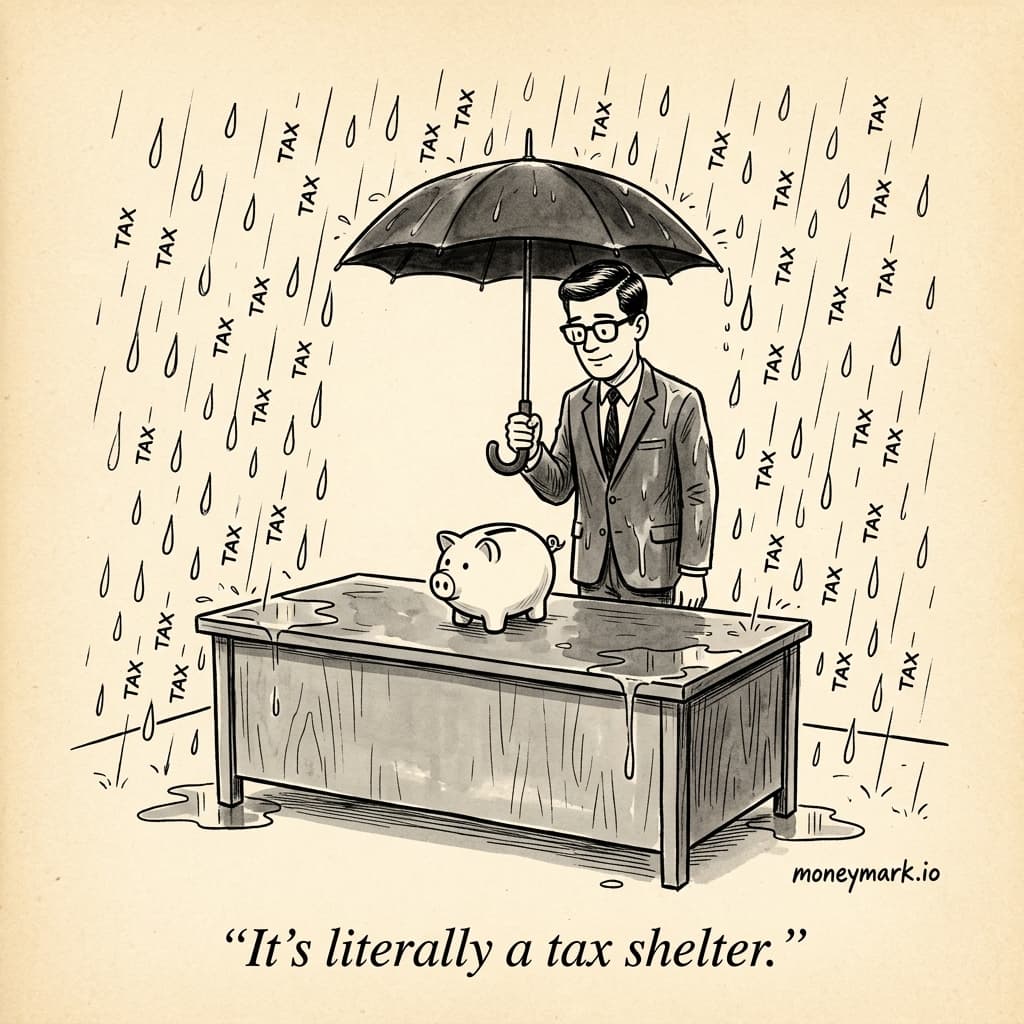
If you have a Canadian job and you've ever filed a tax return, the CRA has been quietly tracking a number on your behalf called RRSP contribution room. Most Canadians use a fraction of it. Some don't use any of it. The RRSP is the most important tax-sheltered account most people don't fully understand.
This is the plain explainer.
The plain definition
An RRSP — Registered Retirement Savings Plan — is a Canadian tax-sheltered account designed to hold retirement savings. The shelter has two parts that work together. First, the money you contribute is deductible from your taxable income in the year you contribute it.1 Contribute $10,000 to your RRSP this year and your taxable income for the year drops by $10,000. The CRA gives back the tax you would have paid on that $10,000 at your marginal rate. Second, while the money stays inside the RRSP, no tax is owed on the dividends, the interest, or the capital gains that the investments earn. The whole thing compounds tax-sheltered.
The bill comes due when you take money out. Every dollar you withdraw from an RRSP in retirement is taxed as ordinary income that year. The structure is called tax-deferred because the tax isn't avoided — it's pushed forward, ideally to a year when your income is lower than it was when you contributed. The marginal rate you pay in retirement is usually lower than the marginal rate you saved at contribution. The gap between those two rates is most of the benefit.
You don't lose the contribution room if you don't use it. Unused room accumulates and carries forward forever. A 45-year-old who's never opened an RRSP might be sitting on twenty years of accumulated room, all of which they can use today.
One concrete example
A Canadian earning $80,000 a year, at a roughly 30% marginal rate, contributes $10,000 to her RRSP. The mechanics:
- In April of the next year, when she files her taxes, the $10,000 contribution reduces her taxable income from $80,000 to $70,000. The CRA refunds the tax she overpaid — roughly $3,000 at her marginal rate. Her net cost of the $10,000 contribution was $7,000.
- The $10,000 inside the RRSP is invested in whatever she chooses — stocks, ETFs, GICs, mutual funds. The dividends, the interest, the capital gains all compound tax-sheltered for as long as the money stays inside.
- In retirement, when she withdraws — say at age 67, drawing $40,000 a year from her RRSP at a 20% marginal rate — she pays $8,000 in tax on a $40,000 withdrawal. The original $10,000 has grown to whatever the investments returned over decades, and the tax bill on the way out is calculated at her now-lower retirement rate.
The maths only works if she actually invests the contributions, doesn't pull the money out before retirement, and lands in a lower tax bracket later. Each of those assumptions deserves to be checked. None of them are automatic.
What it means for the reader
If you have unused RRSP contribution room and your marginal tax rate today is meaningfully higher than what you expect it to be in retirement, you have a high-conviction move sitting in front of you that doesn't require any investing skill. Contribute. Invest the proceeds in a low-cost broad-market ETF. Leave it alone.
The cases where an RRSP is not the right first move are real, though. If your income today is low — say you're a student, or in an early-career year — your marginal rate is probably already lower than what you'll pay in retirement. The TFSA (Tax-Free Savings Account) is the better bucket; you pay tax on the contribution at the low rate now and never pay tax again. The other case: if you expect to need the money in the next few years, the RRSP is the wrong structure. Withdrawals trigger withholding tax and ordinary-income treatment, and the contribution room you used is largely gone forever. RRSPs reward leaving the money alone.
For me, the RRSP isn't the centre of gravity — that role belongs to the LIRA, which holds my commuted pension value and is where the Blue Portfolio actually runs. The RRSP is a complementary account, used for further tax-sheltered savings on top of the LIRA. The two accounts have nearly identical investment menus, so for practical purposes I treat them as one pool with two compartments.
Where this connects
- LIRA — the pension-derived cousin. Same tax shelter, but locked until retirement and frozen at the commuted-value amount.
- TFSA — Tax-Free Savings Account. Post pending. The other major sheltered bucket; complementary, not redundant. Generally the first choice for early-career savers.
- The ETF Portfolio — what most readers should hold inside their RRSP. The shelter does the heavy lifting; the investments inside should be the simplest possible.
The RRSP is the workhorse account for most Canadians' retirement saving. Used well — pre-tax dollars in, tax-deferred compounding, low-cost investments, no early withdrawals — it's one of the largest legal tax breaks the country offers. Used badly, it's a savings account with a tax penalty attached. The difference between the two is almost entirely about discipline.
Footnotes
- CRA — Line 20800 – RRSP deduction
- CRA — Line 20600 – Pension adjustment
- CRA — The Home Buyers' Plan
- CRA — Lifelong Learning Plan
- CRA — Tax rates on withdrawals
— Mark